




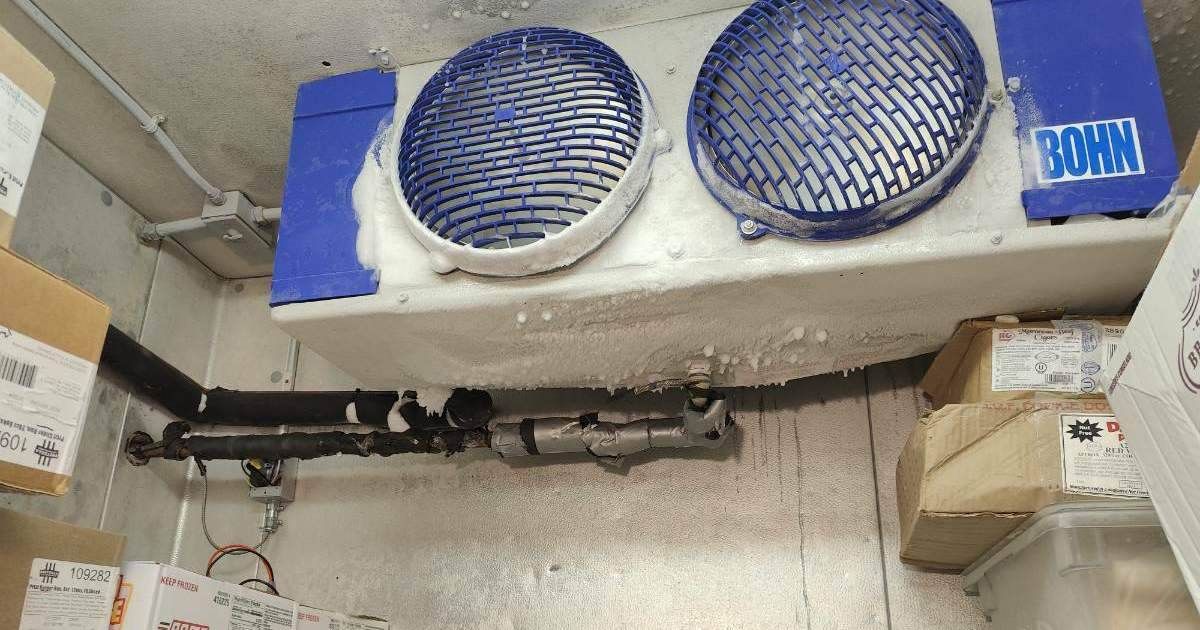
If the evaporator coil in your walk-in freezer is buried in ice, the freezer is usually not making too much cold. It is failing to shed frost. In most cases the defrost system has stopped doing its job, or moist air is getting in faster than the unit can handle.
Here is how to tell which one you are dealing with, what you can safely check on your own, and what to leave alone.
What an iced-up evaporator looks like
- Thick frost covering the fins, sometimes a solid block of ice around the fan
- Ice on the fan guard, the ceiling near the unit or the drain pan
- Ice or a puddle on the floor under the unit
- Weak airflow from the evaporator fan
- Temperature drifting up while the compressor seems to run nonstop
- Product near the unit freezing hard while the far end of the box feels soft
Why a walk-in freezer ices up
The defrost cycle is not running. A freezer coil is supposed to melt its frost on a schedule. If the defrost heater, the timer or controller, or the termination sensor fails, frost just keeps stacking up.
Warm, humid air is getting in. A torn door gasket, a door that does not latch all the way, a missing strip curtain or a door propped open during loading all bring moisture into the box. That moisture lands on the coil and freezes.
The drain line is frozen or clogged. Meltwater that cannot leave refreezes in the pan and builds up into the coil from below.
The evaporator fan is not moving air. Without airflow the coil frosts over unevenly, often starting at one end.
Heavy, warm loads. A big delivery of room-temperature product pushes a lot of moisture into the air at once.
Refrigerant problems can look similar, but they tend to show up as frost on only part of the coil or as a coil that is oddly warm. That one is for a technician.
What you can safely check yourself
- Close the door and see whether it seats and latches fully. Look along the gasket for tears, gaps or a flattened section
- Check that the strip curtain is hanging properly and that nothing is holding the door open
- Look at the evaporator fan: is it spinning, and is air actually coming out
- Note where the ice sits: all over the coil, one section only, or mostly around the drain pan
- Read the controller display and see whether it shows a defrost cycle or an alarm
- Take a few photos of the coil, the drain pan and the controller. They help a lot when you describe the problem on the phone
What not to do
- Do not chip the ice with a screwdriver, ice pick or knife. The coil tubing is thin, and a puncture means a refrigerant leak and a much bigger repair
- Do not use a heat gun, torch or hot water on the coil. There are electrical parts right there, and uneven heat damages the unit
- Do not keep switching the unit off and on hoping it clears. If the cause is still there, the ice comes right back
- Do not write it off because the box is still cold enough. An iced coil is working against you even when the thermometer looks fine
Protecting your product while you wait
Move the most sensitive or most valuable product to another freezer if you have one, and keep the door closed as much as possible. If your controller has a manual defrost option, running one cycle is reasonable. But if the ice returns within days rather than weeks, something is still wrong and thawing again will not fix it.
When to call us
Call if the ice returns after a defrost, if it is thick enough to block the fan, if you see water on the floor, if the temperature is climbing, or if you simply cannot tell what is causing it. It helps if you can tell us when the ice first showed up, what the controller says, how the door is used during the day and the brand and model if you can see them. Photos make the first phone conversation much faster.
Tadam Tech handles walk-in cooler and freezer repair and commercial refrigeration across Chicago and the northwest suburbs. You can see the towns we cover on our locations page. If your cooler is the one acting up, start with what to check in the first 30 minutes, and if the unit is old and keeps coming back with problems, our guide to when to repair and when to replace may help.
Frequently asked questions
Why does the evaporator in my walk-in freezer keep icing up?
Most often the defrost system is not doing its job (a failed defrost heater, timer or termination sensor), or humid air is getting in through a bad door seal or a door that does not close fully. A blocked drain line and a dead evaporator fan can cause it too.
Can I defrost the coil myself?
You can move product out and let the coil thaw on its own, or run a manual defrost if your controller has one. Do not chip the ice with tools or use a heat gun, torch or hot water on the coil: the tubing is thin and a puncture turns a simple ice problem into a refrigerant leak.
Is it safe to keep the freezer running with an iced coil?
For a short time it may keep product frozen, but the ice blocks airflow, so the box gets uneven temperatures and the compressor runs far more than it should. Move the most sensitive product if you can and have it looked at soon.
The ice came back a few days after I defrosted. Why?
That almost always means the cause is still there. A defrost cycle that does not run, a leaking door gasket or a frozen drain line will rebuild the ice quickly, so thawing it again only buys you time.


